Types of Ads Used in Monetized Links: A Technical Breakdown for Publishers
Monetized links generate revenue by showing ads between the click and the final destination. Formats such as interstitials, popunders, push notifications, native pages, and smartlinks are commonly used.
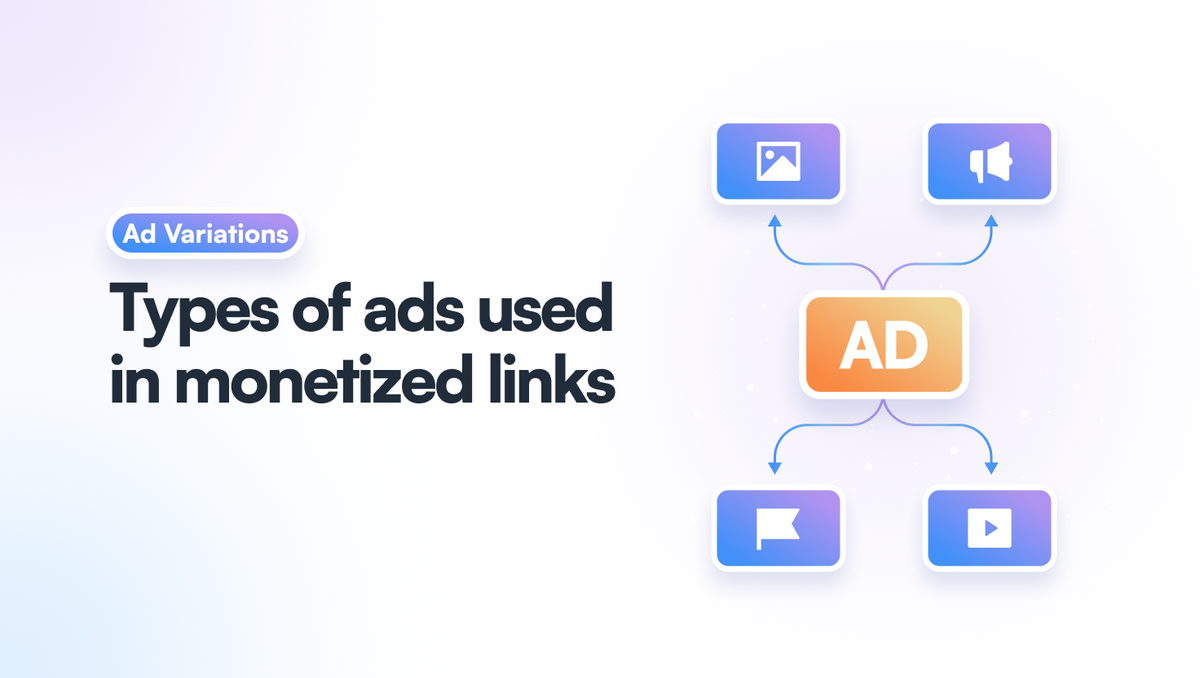
For publishers and affiliates using monetized links, the revenue generated from each click depends almost entirely on one factor: which ad formats are inserted between the click and the destination.
Monetized links function by routing traffic through an intermediate layer where advertising impressions are served before the user reaches the intended URL. However, not all monetization platforms use the same ad formats and the differences matter enormously for both short-term revenue and long-term audience retention.
This article provides a technical examination of the five primary ad formats used in monetized links, explains why platforms mix multiple formats, and offers a framework for evaluating how format selection affects your overall monetization strategy.
How Ads Appear in the Monetized Link Redirect Flow
Before examining specific formats, it's essential to understand the technical mechanism that enables ad insertion within a redirect.
When a user clicks a standard monetized link, the following sequence occurs:
- Click capture: The user clicks a shortened or branded link that resolves to a tracking domain
- Routing decision: The monetization platform evaluates the click based on traffic source, geography, device, and available advertiser demand
- Intermediate page load: Instead of immediately redirecting, the platform loads an intermediate environment (typically a lightweight webview or landing page)
- Ad serving: One or more ad impressions are rendered within this intermediate layer
- Final redirect: After the ad interaction (or a defined delay), the user is forwarded to the original destination URL
The critical distinction between platforms lies in what happens during step four. Some platforms prioritize speed and minimal friction, serving a single impression before redirecting. Others attempt to maximize yield by testing multiple formats sequentially or simultaneously, often called "waterfalling" or "header bidding" for clicks.
Why Monetization Platforms Use Multiple Ad Formats
No single ad format optimizes for all variables simultaneously. Platforms mix formats to solve three competing objectives:
- Maximize fill rate: Different advertisers buy different formats. A platform offering only interstitials will leave money on the table when interstitial demand is low.
- Optimize for traffic segments: Mobile users may respond better to push notification prompts, while desktop users might generate higher CPMs from popunders.
- Balance yield and user experience: High-paying formats often introduce friction. Platforms use lower-friction formats for high-quality traffic they want to retain.
Understanding this mix helps publishers interpret why two platforms can generate wildly different eCPMs from the same traffic source.
Interstitial Ads
How They Work
Interstitials are full screen display ads that appear during natural transition points. In monetized links, they are shown between the user’s click and the final destination. The user sees a static image, rich media creative, or HTML5 experience that covers the entire viewport. A close button or timer typically appears after several seconds, allowing the user to proceed.
Technical Implementation
Interstitials load within the intermediate webview and are typically served via standard display ad tags (often VAST for video or banner tags for static creatives). The platform must balance load time against creative quality because slow loading interstitials increase bounce rates before the redirect completes.
Revenue Profile
- CPM Range: Moderate to high ($5 - $25+ depending on geo and vertical)
- Fill Rate: Generally high across most traffic types
- Advantage: Works across all devices and browsers
- Disadvantage: Introduces intentional friction, some users will abandon
Optimization Insight
Interstitials perform best when the destination page is not immediately expected by the user. For example, if a user clicks a "how-to" article link, a well-designed interstitial can feel like a natural content recommendation. If the click promises immediate access to a specific product, an interstitial creates negative surprise.
Popunder Ads
How They Work
Popunders open the advertiser's landing page in a new browser tab behind the current window. The user continues viewing the original destination (the intended URL), while the popunder loads silently in the background. The user may not discover the popunder until they close their current tab.
Technical Implementation
Popunders rely on browser behavior that allows JavaScript to trigger new window creation. Most modern browsers block popup-style windows, but popunders often succeed because they execute as a direct result of user interaction (the click) rather than asynchronously. The platform must carefully time the popunder trigger to avoid browser popup blockers.
Revenue Profile
- CPM Range: Moderate ($3 - $15)
- Fill Rate: Variable, dependent on advertiser demand for popunder inventory
- Advantage: Non intrusive in the immediate session and associated with a high completion rate for the intended destination
- Disadvantage: May appear spammy to technically savvy users and faces increasing restrictions from modern browsers
Optimization Insight
Popunders perform well for utility traffic because users want to complete a task such as reading an article or checking prices and may not mind a background tab that they can close later. However, users who associate popunders with malware will lose trust in your brand if popunders appear consistently.
Push Notification Ads
How They Work
Push notification ads prompt the user to subscribe to browser push notifications. If the user accepts, the platform (or its advertiser partners) can send notification ads directly to the user's device outside of browsing sessions. The ad format itself is not the notification. It is the subscription prompt that is served during the redirect flow.
Technical Implementation
The intermediate page requests browser permission for push notifications using the browser's native permission UI. If granted, a service worker installs in the background, enabling future notification delivery. The platform earns revenue either from the subscription itself (sold to advertisers as a new subscriber) or from subsequent notification ads.
Revenue Profile
- eCPM Range: Highly variable and can exceed $50 for high converting traffic
- Fill Rate: Limited to browsers supporting push notifications (Chrome, Firefox, Edge)
- Advantage: Creates recurring revenue from a single click
- Disadvantage: Works only on desktop and Android because iOS Safari does not support this format
Optimization Insight
Push notification prompts convert best when users understand the value proposition. Vague "allow notifications" requests perform poorly. Platforms that pair prompts with clear explanations ("Get price alerts for this product") see higher opt-in rates and better long-term audience quality.
Native Ad Pages and Content Recommendation Units
How They Work
Native ad pages present paid links or sponsored content in a format that matches the visual design of the intermediate page. These often appear as "Recommended for You" or "Around the Web" widgets containing links to advertiser content. Users may click multiple native links before proceeding to the original destination.
Technical Implementation
The intermediate page loads a feed of native ads, typically from content recommendation networks like Outbrain or Taboola, or from the platform's own advertiser marketplace. Each ad unit contains a headline, thumbnail image, and sometimes a brief description. Clicking any ad opens a new page (often another monetized path) while the original destination remains accessible.
Revenue Profile
- CPM Range: Moderate to high ($8 - $30) based on engagement rates
- Fill Rate: Strong in major traffic verticals (entertainment, lifestyle, finance)
- Advantage: Feels less intrusive than interstitials because users choose whether to engage
- Disadvantage: Requires users to read and evaluate options, reducing immediate redirect rates
Optimization Insight
Native ad pages perform best when the user's intent is exploratory rather than transactional. A user clicking a "10 best budget headphones" link may genuinely want more product options, making native recommendations feel helpful rather than disruptive.
Smartlinks and Offer-Based Monetization Pages
How They Work
Smartlinks (also called offer walls or gateway pages) display a curated list of monetized offers relevant to the user's traffic source. Instead of a single ad, the user sees multiple offers such as surveys, app installs, email submit offers, or ecommerce deals. The user must complete an offer to unlock the destination, or the offers appear alongside the destination link.
Technical Implementation
The platform analyzes the click's referrer, IP geolocation, device type, and sometimes historical behavior to serve a personalized offer wall. Offers are ranked algorithmically by expected payout and conversion probability. The destination URL appears either as the final option or as a button after offer completion.
Revenue Profile
- eCPM Range: Very high ($20 - $100+) for incentivized traffic
- Fill Rate: Lower, since it requires available offers in the user's geography and vertical
- Advantage: Maximum monetization of high-intent traffic
- Disadvantage: Creates significant user friction and can lead to high abandonment rates
Optimization Insight
Smartlinks should be reserved for traffic segments that have demonstrated tolerance for incentivized offers. This often includes users looking for free rewards or coming from reward based traffic sources. Applying smartlinks to general content traffic typically results in catastrophic bounce rates and audience loss.
Revenue Potential vs User Experience Across Ad Formats
| Format | Revenue Potential | User Friction | Best Use Case |
|---|---|---|---|
| Interstitial | Moderate-High | Moderate | General content, news, blogs |
| Popunder | Moderate | Low | Utility sites, reference content |
| Push Notification | High (recurring) | Low-Medium | Desktop traffic, returning visitors |
| Native Ad Page | Moderate-High | Low | Discovery content, "best of" articles |
| Smartlinks | Very High | Very High | Incentivized traffic, sweeps, rewards |
The table illustrates the fundamental tradeoff: formats generating the highest immediate revenue typically introduce the most friction. Publishers must align format selection with traffic quality expectations.
How Platforms Combine Formats to Maximize CPM
Sophisticated monetization platforms do not rely on a single format. Instead, they employ sequential or simultaneous testing to maximize yield from each click.
Common combination strategies include:
The waterfall approach: The platform attempts the highest-paying format first (e.g., a smartlink offer wall). If the user does not engage within X seconds, the platform falls back to a lower-friction format (e.g., an interstitial), then finally a popunder before redirecting.
Format layering: A popunder opens in a new tab while an interstitial displays in the current tab, effectively monetizing the same click twice.
Traffic-based routing: Mobile traffic receives push notification prompts, desktop traffic receives popunders, and high value GEOs receive offer walls.
Understanding these combinations helps publishers diagnose performance issues. Low eCPM may not indicate low demand. It may indicate that the platform's fallback formats are triggering too frequently due to poor traffic quality.
How to Analyze and Optimize Ad Format Performance in Your Traffic
Once your monetized links are active, the real work begins. Understanding which formats actually drive revenue for specific traffic segments. Most platforms provide aggregate eCPM data, but optimization requires digging deeper into format-by-format performance.
1. Segment eCPM by traffic source and format
A format generating $20 CPM from organic search may deliver $2 CPM from social traffic. Pull reports showing revenue broken down by both format and source. Look for patterns. For example, determine whether your email traffic tolerates interstitials better than your blog audience.
2. Measure completion funnel drop-off
Track how many users who enter the monetization layer actually reach the destination URL. High CPM formats that lose 60% of your audience may destroy long-term value. Compare abandonment rates across formats to calculate true effective CPM after audience loss.
3. Monitor return visitor rates by format exposure
Users who encounter interruptive formats should return at similar rates to those who don't. If your analytics show returning users consistently avoiding pages with certain formats, you have a trust problem.
4. Evaluate latency impact
Some formats require loading multiple scripts or slow creative assets. Test page load times for each format type. If a format adds three seconds to your redirect, you are burning goodwill with every user.
5. Correlate format performance with device and browser
Popunders may convert on desktop Chrome but fail on Safari. Push prompts work only on supported browsers. Run device-level reports to identify where each format actually delivers.
Strategic Recommendations
For publishers serious about long-term monetization, format strategy should evolve with traffic maturity:
New traffic, unproven sources: Prioritize low-friction formats (popunders, native pages) to preserve audience while gathering performance data.
Established traffic with returning users: Introduce interstitials and push notification prompts to increase yield without alienating loyal audiences.
High-intent, transient traffic: Test smartlinks and offer walls aggressively because these users may never return, so it is important to maximize immediate value.
Monitor format performance by segment: The same format that works for US desktop traffic may destroy mobile traffic from India. Let data guide format decisions.
Ultimately, the best monetization platform is not the one that claims the highest CPM. It is the one whose mix of ad formats aligns with your traffic quality, audience expectations, and long term business goals.